




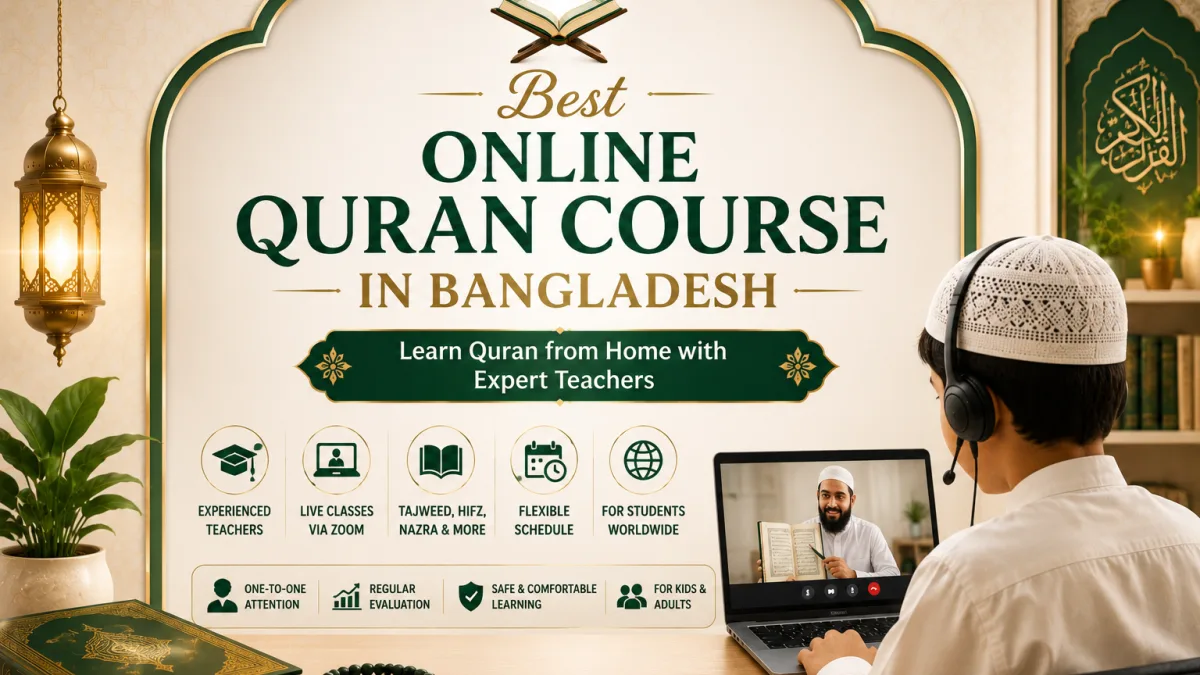
Best Online Quran Course in Bangladesh
Article Overview
~ 7 min readThis guide breaks down the different types of online Quran courses available in Bangladesh, what a genuinely good course should include at each level.
Best Online Quran Course in Bangladesh: A Complete Guide to Choosing the Right One
"Online Quran course" and "online Quran academy" often get used interchangeably — but they're not quite the same question. An academy is the platform; a course is the actual curriculum your child or you will follow. And this is where a lot of families go wrong: they pick a platform based on branding, without checking whether the actual course structure fits their real needs.
This guide breaks down the different types of online Quran courses available in Bangladesh, what a genuinely good course should include at each level, and how to tell a well-structured course from a loosely organized one.
The Main Types of Online Quran Courses
Most reputable platforms in Bangladesh offer some combination of the following courses. Understanding what each one actually covers helps you pick the right starting point.
1. Noorani Qaida Course
The starting point for anyone who can't yet read Arabic script fluently — children and adult beginners alike. A proper Noorani Qaida course covers Arabic letter recognition, correct pronunciation points (Makhraj), joining letters, vowel marks (harakat), and basic Tajweed rules like Madd and Shaddah, all in a structured, step-by-step sequence.
What a good course includes: live correction of every letter, gradual progression (not rushed), and regular revision of earlier lessons.
2. Quran Reading Course (with Tajweed)
Once Qaida is complete, students move to reading actual Quranic text — applying Tajweed rules in real recitation rather than isolated practice pages. This is where fluency and correct rhythm really start to develop.
What a good course includes: gradual increase in surah length and difficulty, ongoing Tajweed correction, and a clear sense of measurable progress (which surahs completed, which rules mastered).
3. Hifz (Memorization) Course
For students aiming to memorize part or all of the Quran. A structured Hifz course paces memorization realistically, builds in regular revision of previously memorized portions (so nothing is forgotten), and includes recitation testing.
What a good course includes: a clear daily/weekly memorization target, mandatory revision cycles, and a tutor who actively listens to full recitations rather than just approving line-by-line.
4. Tafseer & Arabic Language Courses
For those who want to understand the meaning of what they're reading — Quranic Arabic vocabulary, grammar basics, and Tafseer (explanation/commentary) of verses. Usually recommended for older students or adults, once basic reading fluency is solid.
What a good course includes: structured vocabulary building, connection between grammar lessons and actual verses, and Tafseer drawn from recognized scholarly sources.
5. Kids-Specific Combined Courses
Many academies now offer age-adapted programs combining Qaida, basic Tajweed, short surah memorization, and Islamic manners (Adab) into one structured track for children — rather than treating each subject separately.
What a good course includes: age-appropriate pacing, short focused sessions (20–30 minutes), and a curriculum that keeps children engaged rather than overwhelmed.
Red Flags to Watch For in Any Online Quran Course
Not every course that markets itself as "structured" or "professional" actually is. Watch for these warning signs:
No clear curriculum outline — if a platform can't tell you exactly what will be covered week by week, that's a problem.
Pre-recorded video-only courses for reading/Tajweed — recitation correction genuinely requires a live tutor listening in real time.
No trial class offered — reputable academies let you evaluate teaching quality before you commit financially.
Vague tutor credentials — "experienced teacher" without specifics (Hafiz? Alim? Ijaza in what?) is a red flag.
One-size-fits-all pacing — courses that don't adjust speed based on the student's actual progress often leave weaker students behind or bore faster learners.
What Makes Our Courses at Learn Al Quran Online BD Different
We built our course structure specifically around the needs of Bangladeshi students — both in Bangladesh and abroad — rather than adapting a generic curriculum.
- Noorani Qaida, Quran Reading with Tajweed, and Hifz courses, each with a clearly defined, step-by-step curriculum
- Live, one-on-one classes — every mistake corrected in real time, not left for a video to "hopefully" catch
- Qualified tutors fluent in Bangla and English, so instructions are never lost in translation for kids raised abroad
- Flexible scheduling built around US, UK, Canada, and Australia time zones, as well as Bangladesh
- Regular parent progress reports, so you always know exactly where your child stands in the course
- Free trial class before you commit to any course
- How to Choose the Right Course for Your Situation
- Complete beginner, any age → Start with Noorani Qaida
- Can read Arabic but pronunciation needs correction → Quran Reading with Tajweed course
- Wants to memorize Quran → Hifz course (after Qaida/reading fluency is solid)
- Wants to understand meaning, not just recite → Tafseer or Arabic language course
- Young child (4–9 years old) → Kids-specific combined course
Frequently Asked Questions
How long does a Noorani Qaida course typically take?
With consistent live sessions 3–5 times per week, most students complete Noorani Qaida within 2 to 4 months. Progress depends more on consistency than raw ability.
Can I switch courses partway through if it's not the right fit?
Reputable academies, including ours, allow you to adjust course direction based on your actual progress — this is one reason a trial class and ongoing progress tracking matter so much.
Is a combined kids' course better than separate Qaida and Tajweed courses?
For younger children, yes — a combined, age-adapted course tends to keep engagement higher than treating each subject in isolation. Older children and teens often benefit more from more focused, subject-specific courses.
Do I need to know Arabic before starting a Tafseer course?
Not necessarily, but basic Quran reading fluency is usually required first, since Tafseer courses build directly on verses you're already able to read.
Start with the Right Course, Not Just the Right Platform
Choosing an academy matters — but choosing the right course, with a genuinely structured curriculum and live correction, matters even more. The best platform in the world can't help if the course itself is vague or poorly paced.
Book a free trial class today with Learn Al Quran Online BD and find the exact course that fits where you or your child are starting from.
Explore Learn Al Quran Online BD
Looking for a trusted way to learn the Quran and improve your Islamic knowledge online? Learn Al Quran Online BD provides live online learning opportunities for children and adults, helping students learn from the comfort of home.
Our Current Courses
-
Quran with Tajweed — Learn Quran reading with proper Tajweed and pronunciation.
-
Smart Maktab Learning — A structured Islamic learning program for children.
-
Nazera Quran — Build confidence in Quran reading through guided online lessons.
-
Hifzul Quran — Learn and memorize the Quran through structured online Hifz lessons.
-
Quran Learning for Adults — Learn Quran online with lessons designed for adult learners.
-
Spoken English for Kids — Help children develop practical English speaking skills through live online learning.
-
Spoken English for Adults — Improve your English speaking skills through structured live online lessons.
A Note Before You Choose
Whatever academy you choose, the questions above will help you evaluate it honestly. You can learn more about our approach on our About Us page, or Contact Us directly with any questions. Or WhatsApp: +880 1410-745663
Ready to Start Learning?
You can take the next step by Book a Free Trial Class and experiencing our online learning approach.