

IELTS Speaking vs. Spoken English Course: What's the Difference?
Article Overview
~ 6 min readThey're actually built for different goals, and picking the wrong one can waste time and money. This guide breaks down exactly how they differ.
IELTS Speaking vs. Spoken English Course: What's the Difference?
"Should I join an IELTS speaking course or a spoken English course?" is a question a lot of learners in Bangladesh get stuck on — especially since both involve speaking English and are often marketed similarly. They're actually built for different goals, and picking the wrong one can waste time and money. This guide breaks down exactly how they differ.
The Core Difference in One Line
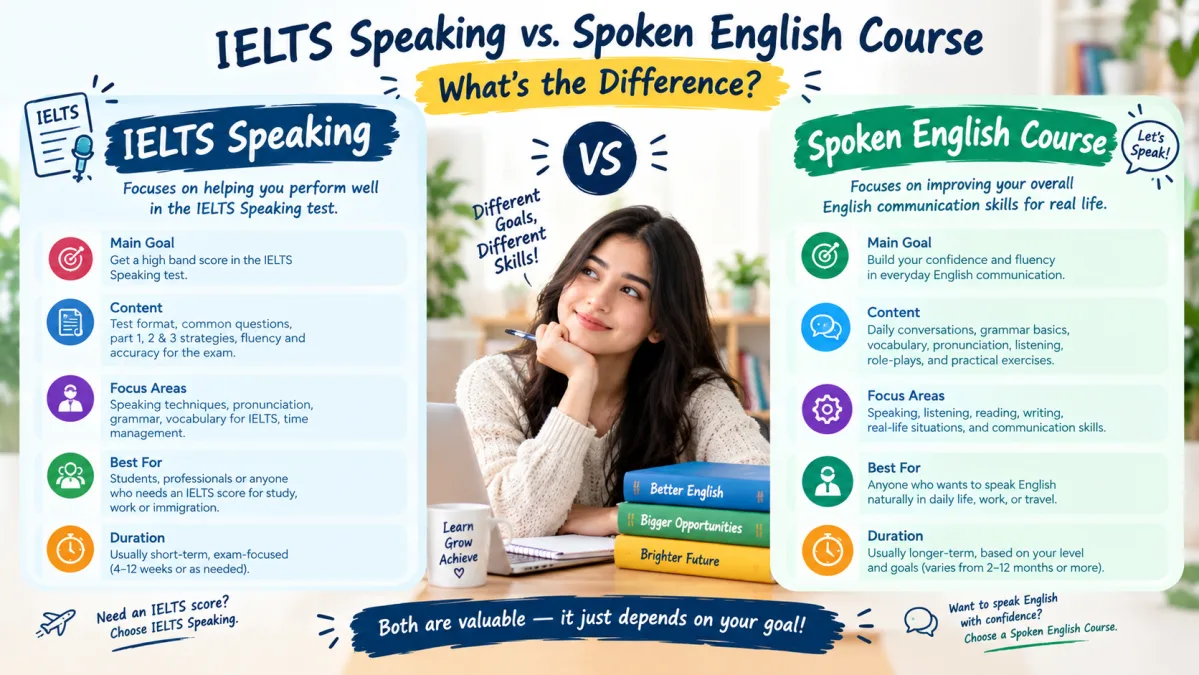
An IELTS speaking course trains you to perform well in a specific, structured exam format within a fixed time limit. A spoken English course trains you to communicate naturally and confidently in real-life situations — conversations, interviews, workplace communication — without a fixed test structure.
IELTS Speaking Course: What It Actually Covers
- Exam format familiarity — understanding the three-part IELTS speaking test structure (introduction, long turn, discussion)
- Timed response practice — learning to organize thoughts and speak fluently within strict time limits
- Band descriptor alignment — practicing to hit specific scoring criteria (fluency, vocabulary range, grammar accuracy, pronunciation)
- Topic-specific vocabulary — covering common IELTS topics (education, technology, environment, etc.)
- Examiner expectations — understanding what examiners are specifically listening for
Spoken English Course: What It Actually Covers
- Everyday conversational fluency — comfortably discussing daily life, work, and casual topics
- Natural, unscripted speaking — responding spontaneously without a fixed test structure
- Practical scenarios — job interviews, phone calls, meetings, social situations
- Confidence building — reducing hesitation and nervousness in real conversations
- Broader vocabulary and grammar — not limited to exam-specific topics or timing
Side-by-Side Comparison
| Factor | IELTS Speaking Course | Spoken English Course |
|---|---|---|
| Primary goal | Score well on a specific exam | Communicate confidently in real life |
| Structure | Follows fixed exam format | Flexible, based on real conversation |
| Time constraints | Practiced under strict timing | Natural pacing, no fixed time limit |
| Vocabulary focus | Exam-common topics | Broad, everyday and professional topics |
| Best for | Students/professionals needing IELTS scores for study or migration abroad | Anyone wanting to speak more confidently day-to-day |
| Assessment style | Band-score criteria (fluency, grammar, vocabulary, pronunciation) | General improvement in fluency and confidence |
Which One Do You Actually Need?
| Your Situation | Recommended Course |
|---|---|
| Applying to study or migrate abroad and need a specific IELTS band score | IELTS speaking course |
| Preparing for job interviews or workplace communication | Spoken English course |
| Want to feel more confident in daily conversations | Spoken English course |
| Already speak reasonably well but need exam-specific practice | IELTS speaking course |
| Complete beginner needing foundational speaking skills first | Spoken English course, then IELTS prep if needed later |
Can You Do Both?
Yes — in fact, many learners benefit from building general spoken English confidence first, then moving into IELTS-specific preparation once they can already communicate reasonably well. Trying to jump straight into IELTS speaking practice without foundational conversational skills often makes the exam-specific training less effective, since you're trying to learn two things (speaking confidently, and speaking within exam constraints) at the same time.
Common Mistakes When Choosing Between the Two
- Enrolling in an IELTS course without a specific need for an IELTS score, when a general spoken English course would serve daily goals better
- Assuming an IELTS speaking course will build the same conversational confidence needed for job interviews or workplace communication
- Skipping foundational spoken English practice and going straight into exam-focused training as a complete beginner
Frequently Asked Questions
If I do well in IELTS speaking, will I automatically be good at everyday conversation? Not necessarily. IELTS speaking trains you for a specific, structured format, which doesn't always translate directly into natural, spontaneous conversation skills.
Do I need a spoken English course before starting IELTS preparation? Not always required, but if you're a beginner or feel very hesitant speaking, building basic conversational confidence first often makes IELTS-specific training more effective.
Which course is better for job interview preparation? A spoken English course, since job interviews require natural, unscripted communication rather than the structured format used in IELTS speaking tests.
Is IELTS speaking harder than general spoken English? They test different things rather than one being strictly harder — IELTS adds the challenge of specific timing and scoring criteria on top of general speaking ability.
Can one course provider offer both types of training? Yes, many providers offer both, sometimes as separate courses or as a combined package — it's worth checking what's included and whether it truly covers both goals if you need them.
Not Sure Which You Need?
If you're unsure whether you need exam-focused training or general speaking confidence, it helps to talk it through before choosing. Join a free trial class with us and we'll help you figure out the right starting point for your specific goal. Visit our Spoken English course page to book your free trial today.
Explore Learn Al Quran Online BD
Looking for a trusted way to learn the Quran and improve your Islamic knowledge online? Learn Al Quran Online BD provides live online learning opportunities for children and adults, helping students learn from the comfort of home.
Our Current Courses
-
Quran with Tajweed — Learn Quran reading with proper Tajweed and pronunciation.
-
Smart Maktab Learning — A structured Islamic learning program for children.
-
Nazera Quran — Build confidence in Quran reading through guided online lessons.
-
Hifzul Quran — Learn and memorize the Quran through structured online Hifz lessons.
-
Quran Learning for Adults — Learn Quran online with lessons designed for adult learners.
-
Spoken English for Kids — Help children develop practical English speaking skills through live online learning.
-
Spoken English for Adults — Improve your English speaking skills through structured live online lessons.
A Note Before You Choose
Whatever academy you choose, the questions above will help you evaluate it honestly. You can learn more about our approach on our About Us page, or Contact Us directly with any questions. Or WhatsApp: +880 1410-745663
Ready to Start Learning?
You can take the next step by Book a Free Trial Class and experiencing our online learning approach.