





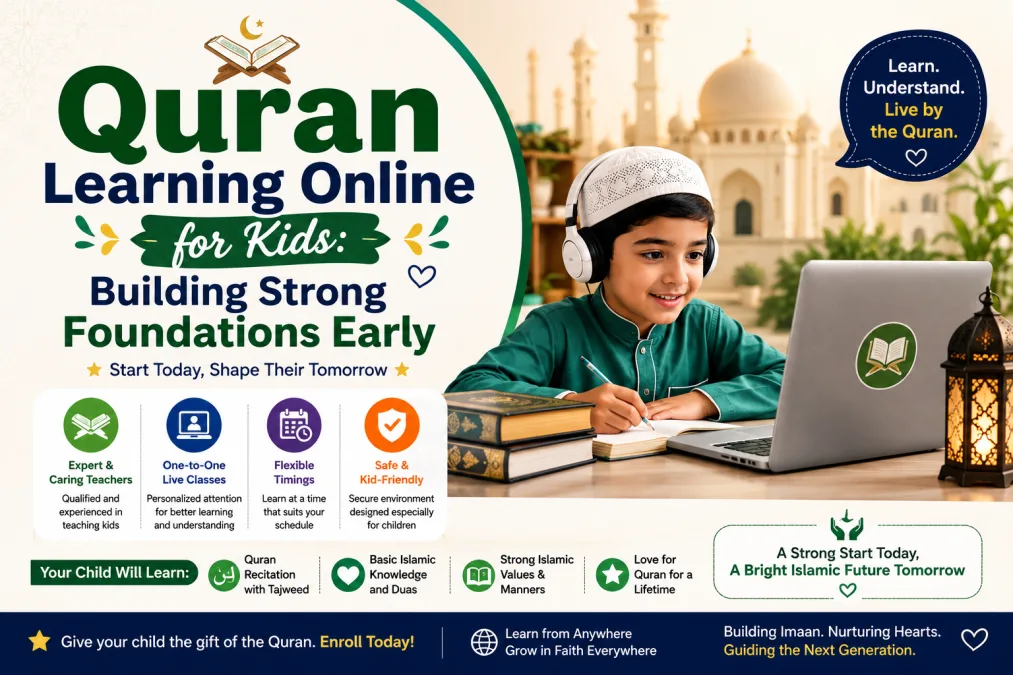
Quran Learning Online for Kids: Building Strong Foundations Early
Article Overview
~ 6 min readThis guide focuses specifically on foundational learning for kids: what it consists of, why rushing past it causes problems later, and how to make sure your child's early Quran education sets them up for real, lasting success.
Quran Learning Online for Kids: Building Strong Foundations Early
Every parent wants their child's Quran learning journey to start on solid ground — but what does a genuinely strong foundation actually look like in practice, and why does it matter so much in the early stages? This guide focuses specifically on foundational learning for kids: what it consists of, why rushing past it causes problems later, and how to make sure your child's early Quran education sets them up for real, lasting success.
Why Foundations Matter More Than Speed
It's tempting, as a parent, to want visible progress quickly — a child reading full pages, reciting confidently, moving fast. But Quran learning isn't a race, and foundational stages that are rushed tend to create problems that resurface later: mispronounced letters that become habitual, weak understanding of basic Tajweed rules, or shaky reading fluency that makes memorization far harder down the line. A slower, more thorough foundation almost always produces a stronger long-term result.
What a Strong Foundation Actually Includes
1. Accurate Makhraj from the very beginning Makhraj — the correct articulation point for each Arabic letter — is the single most important foundational skill. Children who learn this accurately from day one avoid years of correcting bad habits later. This is also exactly why live, one-to-one teaching matters so much at this stage; a recorded video simply cannot correct a child's specific pronunciation in real time.
2. Letter recognition paired with sound, not memorized shapes alone A child should connect each Arabic letter with its correct sound naturally, not just memorize what a letter "looks like" without truly internalizing its pronunciation.
3. Gradual introduction of basic Tajweed concepts Even before reaching full Quran reading, foundational Tajweed ideas — how letters interact, basic elongation rules — should be introduced gently, building intuition rather than overwhelming a young learner with formal rules too early.
4. Confidence and comfort with the learning process itself A strong foundation isn't purely academic — it also means a child feels comfortable, unafraid to make mistakes, and genuinely engaged with learning, rather than anxious or pressured.
5. Consistency through routine Foundational skills solidify through regular, predictable practice — a fixed weekly class schedule plus short daily practice at home builds habits far more effectively than sporadic, irregular sessions.
How Age Affects Foundational Learning
Ages 5–7 The most natural window for foundational learning — young children absorb new sounds and pronunciation patterns with remarkable ease at this stage. Lessons are typically shorter, playful, and repetition-heavy.
Ages 7–10 Still an excellent window for building foundations, often with slightly faster progress than younger children due to improved focus and reading readiness in general (including from school).
Ages 10–15 Children starting later can still build excellent foundations — the process simply moves a bit faster, since older children typically grasp abstract rules more quickly, even if unlearning any existing bad habits takes some extra attention.
Signs Your Child's Foundation Is Genuinely Solid
- Clear, accurate pronunciation of individual letters, not just "close enough" sounds
- Ability to sound out unfamiliar words correctly, not just recognize memorized ones
- Basic understanding of why certain letters are elongated or pronounced differently in context
- Growing confidence reading aloud, without excessive hesitation or guessing
What Parents Can Do to Support Foundation-Building at Home
- Avoid rushing your child toward "reading the Quran" before foundational sounds are solid
- Practice little and often — 10 minutes daily is more effective than a single long session once a week
- Celebrate accuracy, not just speed — praise correct pronunciation, not just fast reading
- Stay in contact with the teacher about whether foundational stages are genuinely secure before moving forward
- Be patient — foundational stages can feel slow, but they pay off significantly in later stages
Frequently Asked Questions
How long should the foundational stage take before moving to full Quran reading? This varies by child, but it's typically the first few months of a structured Nazera course — rushing this stage to "catch up" faster usually backfires later.
Is it normal for a child to seem to progress slowly at first? Yes, completely normal — foundational learning often looks slower on the surface because it's focused on accuracy over speed, which pays off significantly in later stages.
Can a weak foundation be corrected later if it wasn't built properly the first time? Yes, though it typically takes more effort and patience than building it correctly the first time — which is exactly why choosing live, one-to-one teaching from the start matters so much.
Does foundational learning look different for children versus adult beginners? The core content is similar, but pacing and teaching style differ — adults often move through foundational material a bit faster, given generally stronger existing reading and learning skills.
How do I know if my child's current teacher is building foundations properly? Ask specific questions — is Makhraj being corrected consistently? Is your child's pronunciation actually improving, not just their reading speed? A good teacher will have clear, specific answers.
Give Your Child the Strongest Possible Start
A well-built foundation shapes everything that follows in your child's Quran learning journey. Learn Al Quran Online BD offers certified Hafez and Qari teachers experienced in foundational teaching for young beginners, live one-to-one classes, and a free trial class to see this approach in action.
Explore Learn Al Quran Online BD
Looking for a trusted way to learn the Quran and improve your Islamic knowledge online? Learn Al Quran Online BD provides live online learning opportunities for children and adults, helping students learn from the comfort of home.
Our Current Courses
-
Quran with Tajweed — Learn Quran reading with proper Tajweed and pronunciation.
-
Smart Maktab Learning — A structured Islamic learning program for children.
-
Nazera Quran — Build confidence in Quran reading through guided online lessons.
-
Hifzul Quran — Learn and memorize the Quran through structured online Hifz lessons.
-
Quran Learning for Adults — Learn Quran online with lessons designed for adult learners.
-
Spoken English for Kids — Help children develop practical English speaking skills through live online learning.
-
Spoken English for Adults — Improve your English speaking skills through structured live online lessons.
A Note Before You Choose
Whatever academy you choose, the questions above will help you evaluate it honestly. You can learn more about our approach on our About Us page, or Contact Us directly with any questions. Or WhatsApp: +880 1410-745663
Ready to Start Learning?
You can take the next step by Book a Free Trial Class and experiencing our online learning approach.