




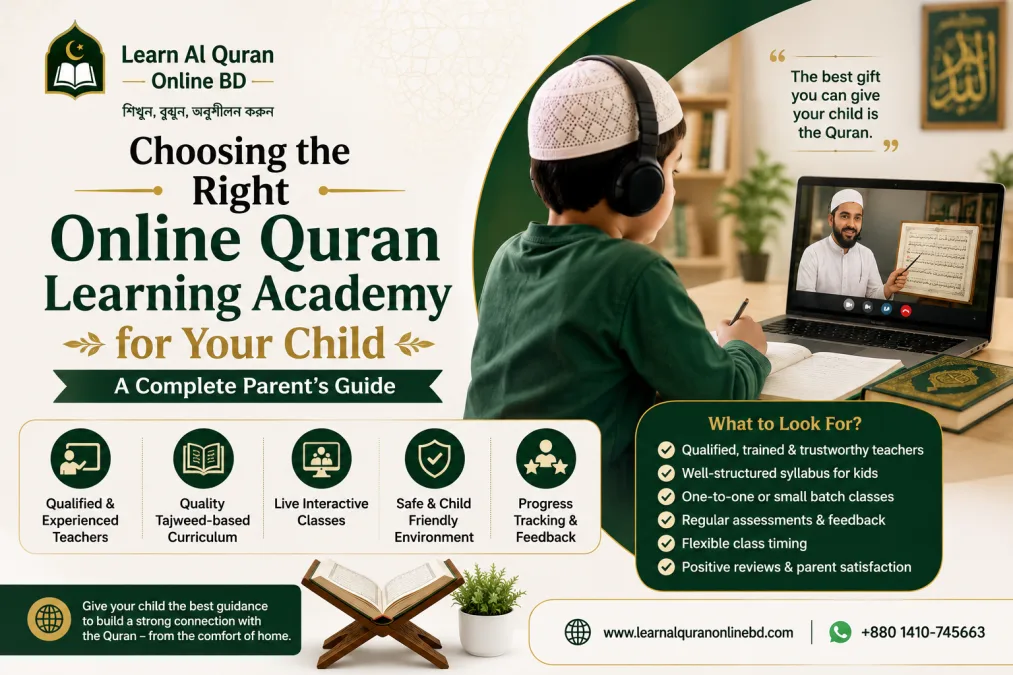
Choosing the Right Online Quran Learning Academy for Your Child
প্রবন্ধের সারসংক্ষেপ
~ 5 মিনিট পড়ার সময়This guide walks you through exactly what to look for, and what to avoid, when choosing an online Quran learning academy for your child.
Choosing the Right Online Quran Learning Academy for Your Child
As a parent living abroad, choosing who teaches your child the Quran isn't a small decision — it shapes how they connect with their faith, their language, and their identity for years to come. With so many "online Quran academies" advertising on social media, it's easy to feel overwhelmed. This guide walks you through exactly what to look for, and what to avoid, when choosing an online Quran learning academy for your child.
Why This Decision Matters More When You Live Abroad
When you're raising children in the UK, USA, Canada, or the Middle East, you don't have the option of simply asking a trusted neighborhood Hafez or walking into a local madrasa the way your parents might have back home. The academy you choose becomes your child's only direct connection to structured Quran education — which means the usual local trust signals (a mosque you attend, a teacher your community knows) aren't automatically there. You have to build that trust from scratch, often based on a website and a first conversation.
Key Factors to Check Before Enrolling Your Child
1. Teacher Qualifications This is the single most important factor. Ask directly: Is the teacher a certified Hafez or Qari? Where did they study — a recognized madrasa, or an institution like Al-Azhar University? A real academy will be transparent about this, not vague.
2. Live Classes vs. Pre-Recorded Content Some platforms sell packages of recorded videos and call it an "academy." That's not Quran teaching — it's a video library. Your child needs a live teacher who listens to their recitation in real time and corrects mistakes as they happen, especially for Makhraj (pronunciation points) and Tajweed rules.
3. Age-Appropriate Curriculum A 6-year-old and a 13-year-old shouldn't be taught the same way. Look for an academy that separates its programs by age and level — starting with Arabic letter recognition for young beginners, progressing through Nazera (fluent reading), and offering a dedicated Hifz (memorization) track for children ready to move further.
4. Class Format: One-to-One or Small Group One-to-one classes allow the teacher to fully focus on your child's specific weaknesses. If group classes are offered, check the group size — a class of 15 children means your child gets very little individual correction time.
5. Scheduling Flexibility Across Time Zones As a parent abroad, your evening might be Bangladesh's early morning. A serious academy will work with you to fit classes into your family's routine, not force you into times that don't work.
6. Parental Involvement and Transparency Can you sit in on classes? Can you see a report of your child's progress? A trustworthy academy welcomes parental oversight rather than treating classes as a black box.
7. A Free Trial Class This is non-negotiable. Never commit to a paying package without first observing how the teacher interacts with your child, how clearly they explain things, and whether your child feels comfortable.
Red Flags to Watch Out For
- No mention of teacher credentials anywhere on the website
- Pressure to pay immediately, with no trial class offered
- No fixed curriculum — just "we'll figure out what to teach as we go"
- No direct contact method (only a contact form, no phone or WhatsApp)
- Reviews or testimonials that seem generic or impossible to verify
What a Well-Structured Academy Should Offer
At minimum, a genuine online Quran academy for children should provide:
- A Nazera Quran course for learning correct, fluent reading from the basics
- A Hifz Quran course for children ready to begin memorization, guided step-by-step through all 30 Para
- A Tajweed-focused course for refining pronunciation and recitation rules
- Optionally, a broader Islamic foundation program (sometimes called Maktab-style learning) covering wider Islamic knowledge alongside Quran study
- Certified teachers, live video classes, and clear progress tracking
Frequently Asked Questions
How do I verify a teacher is actually certified? Ask directly during your trial class conversation — a real academy will readily share the teacher's educational background (madrasa, Hifz certification, or university such as Al-Azhar). Hesitation or vague answers are a warning sign.
Is a group class or one-to-one class better for my child? For beginners, especially younger children, one-to-one classes generally lead to faster, more accurate progress because the teacher can focus entirely on correcting that child's specific pronunciation and pace.
What age should my child start online Quran classes? Most academies accept children from around age 5, starting with Arabic letter recognition before moving into full reading and Tajweed as they grow.
Can I switch teachers if my child isn't comfortable? A good academy should allow this — every child learns differently, and a mismatch in teaching style is a legitimate reason to request a change.
How do I know if the academy will suit a child living outside Bangladesh? Confirm they've taught students abroad before and that class timings are genuinely flexible across time zones — not just claimed, but demonstrated in your first conversation.
See It for Yourself — Book a Free Trial Class
The best way to judge any academy is to watch a real class happen. Learn Al Quran Online BD offers certified Hafez and Qari teachers, live one-to-one classes on Zoom or Google Meet, and structured courses for every age — with a free trial class so you can decide with confidence.
📞 Book a free trial class: learnalquranonlinebd.com/free-trial-class 💬 WhatsApp: +880 1410-745663