





Online Quran Learning Classes: How Live Sessions Work
প্রবন্ধের সারসংক্ষেপ
~ 5 মিনিট পড়ার সময়This post walks through exactly how live online Quran classes work, step by step, so you know what to expect before your first session.
Online Quran Learning Classes: How Live Sessions Work
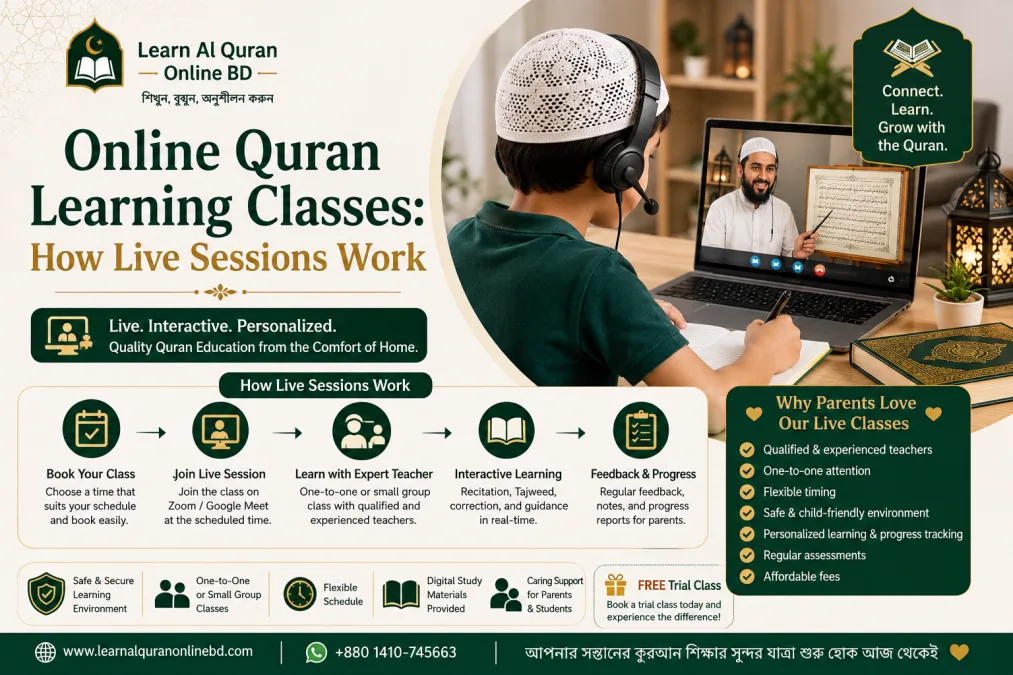
If you've never taken an online Quran class before, it's natural to wonder what actually happens once you log in. Is it just a video call? How does correction work through a screen? Can a teacher really tell if you're pronouncing something wrong from thousands of miles away? This post walks through exactly how live online Quran classes work, step by step, so you know what to expect before your first session.
Live Classes vs. Recorded Content: A Key Difference
Before anything else, it's worth understanding this distinction clearly. A recorded course is a set of pre-made videos you watch on your own time — there's no teacher listening to you, no correction, no interaction. A live class is a real-time video call where a certified teacher is actually present, listening to your (or your child's) recitation and correcting mistakes as they happen.
For something as precision-dependent as Quran recitation — where a small change in pronunciation can change meaning — live correction isn't optional. It's the entire point.
Step-by-Step: What Happens in a Live Online Quran Class
1. Joining the class At the scheduled time, you or your child join a live video call via Zoom or Google Meet using a link shared in advance. No special software purchase is needed — just the app and a stable internet connection.
2. Brief check-in and revision The teacher usually starts with a short recap of the previous lesson, checking retention before introducing anything new. This might mean re-reading a few lines or reviewing a Tajweed rule covered last time.
3. New lesson introduction Depending on the course (Nazera, Hifz, Tajweed, or Adult learning), the teacher introduces the day's new material — a new Arabic letter, a new Tajweed rule, a new portion to memorize, or a new passage to read.
4. Guided reading and real-time correction This is the core of the class. The student reads aloud while the teacher listens closely, pausing to correct Makhraj (pronunciation points), Tajweed application, or memorization accuracy immediately — not after the fact. This immediate feedback loop is very difficult to replicate with recorded lessons or self-study apps.
5. Practice assignment (Mashq) Before the class ends, the teacher typically assigns practice for the student to work on independently before the next session — repeating a passage, reviewing a rule, or preparing new material.
6. Class wrap-up The teacher briefly summarizes what was covered and what to expect next time, so both student and parent (if applicable) know exactly where things stand.
How Correction Actually Works Over Video Call
A common concern is whether a teacher can genuinely hear pronunciation issues through a screen. In practice, audio quality on modern video platforms is more than sufficient for this — Tajweed correction has been taught this way for years, including to international students learning from teachers in Bangladesh and the Middle East. Teachers are trained to listen closely for Makhraj errors, elongation (Madd) mistakes, and rule application, the same way they would in person.
Class Formats You Might Encounter
- One-to-one classes — the teacher's full attention is on a single student; generally the fastest way to improve, especially for children
- Small group classes — a few students learning together, often used for revision or foundational lessons
- Age-specific formats — teaching style and pacing differ significantly between a 6-year-old beginner and an adult starting from scratch
What You Need Before Your First Class
- A device with a camera and microphone (phone, tablet, or laptop)
- A stable internet connection
- Zoom or Google Meet installed
- A quiet, distraction-free space, ideally at a consistent time each week
- A Quran or Nazera book (physical or digital), as advised by your teacher
Frequently Asked Questions
Do I need to buy special software for live classes? No — classes typically run on Zoom or Google Meet, both of which are free to use for joining a call.
How long does a typical class session last? Session length varies by course and age group, but sessions are generally structured to be long enough for real progress while staying manageable for a child's attention span — your teacher will confirm exact timing when you enroll.
What happens if the internet connection drops during class? Most teachers will simply reconnect and continue from where the class left off; occasional connection issues don't disrupt the overall course structure.
Can I record the class for later review? This depends on the platform's policy and teacher preference — it's best to ask your teacher directly if you'd like to review sessions afterward.
Is a live class really more effective than a Quran learning app? For accuracy of pronunciation and Tajweed, yes — apps and recorded content can't listen to you and correct mistakes in real time the way a live teacher can, which is especially important in the early stages of learning.
Experience a Live Class for Yourself
The best way to understand how live online Quran classes work is to simply attend one. Learn Al Quran Online BD offers a free trial class with a certified Hafez or Qari teacher, so you can see the real-time teaching and correction process firsthand before enrolling.
📞 Book a free trial class: learnalquranonlinebd.com/free-trial-class 💬 WhatsApp: +880 1410-745663