




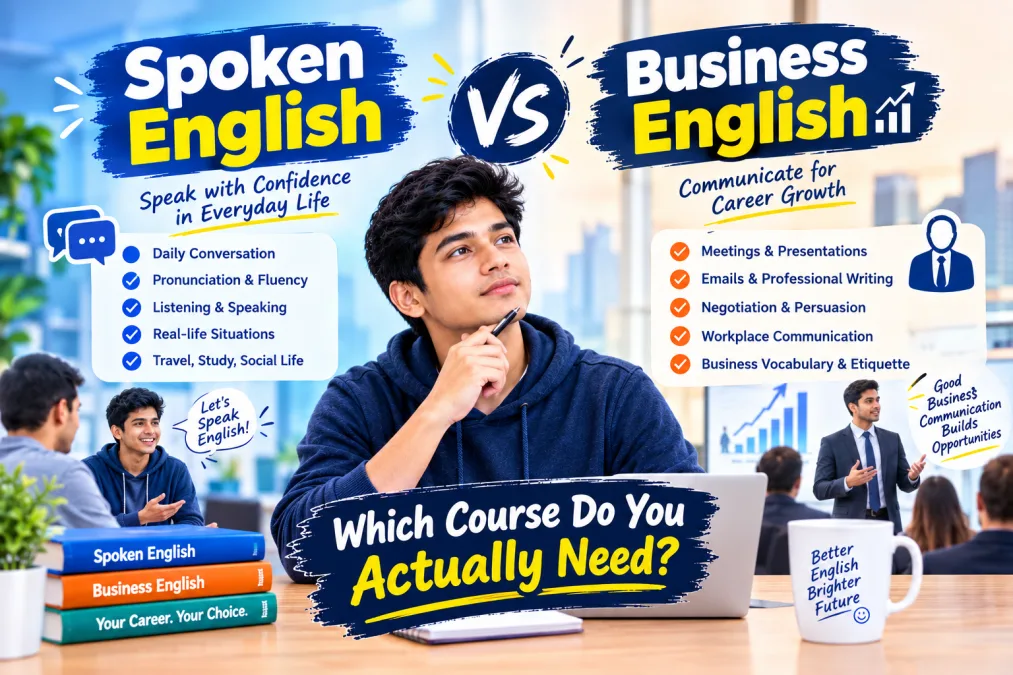
Spoken English vs. Business English: Which Course Do You Actually Need?
প্রবন্ধের সারসংক্ষেপ
~ 6 মিনিট পড়ার সময়Choosing the wrong one can mean spending time on content that doesn't actually match what you need at work or in daily life. This guide breaks down the real differences so you can pick the right course for your specific goal.
Spoken English vs. Business English: Which Course Do You Actually Need?
"Spoken English" and "Business English" are often marketed as similar products, but they're designed to solve different problems. Choosing the wrong one can mean spending time on content that doesn't actually match what you need at work or in daily life. This guide breaks down the real differences so you can pick the right course for your specific goal.
The Core Difference in One Line
A spoken English course builds general conversational confidence and fluency for everyday situations. A business English course builds on existing English ability to focus specifically on professional communication — emails, meetings, presentations, and workplace etiquette.
What Spoken English Courses Typically Cover
- Everyday vocabulary and common sentence structures
- General conversational confidence and fluency
- Pronunciation and natural speaking rhythm
- Broad topics: daily life, family, hobbies, travel, opinions
- Foundational grammar reinforced through speaking practice
Best suited for: Learners building general confidence, students, or anyone who wants to communicate more naturally in day-to-day situations.
What Business English Courses Typically Cover
- Professional email writing and formal correspondence
- Meeting participation — contributing ideas, agreeing/disagreeing politely, summarizing discussions
- Presentation skills and structuring professional talks
- Negotiation and client communication language
- Industry-specific vocabulary relevant to the learner's field
- Workplace etiquette and appropriate formality levels
Best suited for: Working professionals who already have reasonable conversational English but need to sound more polished and effective specifically in a workplace context.
Side-by-Side Comparison
| Factor | Spoken English Course | Business English Course |
|---|---|---|
| Primary goal | General conversational confidence | Professional workplace communication |
| Typical starting level | Beginner to intermediate | Intermediate or higher (assumes conversational base) |
| Content focus | Daily life, broad topics | Emails, meetings, presentations, negotiations |
| Vocabulary | Everyday, general | Professional, industry-specific |
| Best for | Students, beginners, general confidence-building | Working professionals, career advancement |
Which One Do You Actually Need?
| Your Situation | Recommended Course |
|---|---|
| Complete beginner or still hesitant in basic conversation | Spoken English course first |
| Comfortable with daily conversation but nervous in meetings or emails at work | Business English course |
| Preparing for a job interview | Spoken English course (interview-focused) |
| Already employed and need to communicate with international clients | Business English course |
| Student preparing for future career, not yet employed | Spoken English course, with business English later if needed |
| Need to write professional emails but already comfortable speaking | Business English course, focused on written/formal communication |
Can You Take Both?
Yes, and for many working professionals, this is actually the most effective path: build general conversational confidence first through a spoken English course, then move into business English once you can already hold a natural conversation. Attempting business English content — meeting phrases, negotiation language, formal presentations — without foundational conversational fluency often means practicing content you can't yet use naturally in real situations.
Common Mistakes When Choosing Between the Two
- Enrolling in a business English course as a complete beginner, before building basic conversational fluency
- Assuming a spoken English course alone will prepare you for advanced workplace communication like negotiations or formal presentations
- Choosing based on which sounds more "professional" rather than what actually matches your current level and immediate goal
Frequently Asked Questions
Do I need to master spoken English before starting business English? Not necessarily master it, but having reasonable conversational comfort makes business English training more effective, since you can apply professional phrases naturally rather than memorizing them without a speaking foundation.
Is business English harder than general spoken English? It's not necessarily harder, but it assumes a certain baseline of conversational ability and focuses on more specific, formal contexts like meetings and emails.
Which course is better for job interview preparation? A spoken English course with interview-focused practice is usually more directly useful, since interviews require natural, confident conversation rather than the specific formats used in business meetings or emails.
Can students benefit from business English courses? It can be useful for students planning to enter the workforce soon, but building general spoken confidence first typically provides a stronger foundation.
How do I know if I'm ready for business English training? If you can hold a natural conversation in English without significant hesitation and want to focus specifically on professional communication skills, you're likely ready for business English content.
Find the Right Starting Point
Not sure whether you need general speaking confidence or workplace-specific skills? Join a free trial class with us and we'll help you identify the right starting point for your goals. Visit our Spoken English course page to book your free trial today.
Explore Learn Al Quran Online BD
Looking for a trusted way to learn the Quran and improve your Islamic knowledge online? Learn Al Quran Online BD provides live online learning opportunities for children and adults, helping students learn from the comfort of home.
Our Current Courses
-
Quran with Tajweed — Learn Quran reading with proper Tajweed and pronunciation.
-
Smart Maktab Learning — A structured Islamic learning program for children.
-
Nazera Quran — Build confidence in Quran reading through guided online lessons.
-
Hifzul Quran — Learn and memorize the Quran through structured online Hifz lessons.
-
Quran Learning for Adults — Learn Quran online with lessons designed for adult learners.
-
Spoken English for Kids — Help children develop practical English speaking skills through live online learning.
-
Spoken English for Adults — Improve your English speaking skills through structured live online lessons.
A Note Before You Choose
Whatever academy you choose, the questions above will help you evaluate it honestly. You can learn more about our approach on our About Us page, or Contact Us directly with any questions. Or WhatsApp: +880 1410-745663
Ready to Start Learning?
You can take the next step by Book a Free Trial Class and experiencing our online learning approach.