




What Is the Difference Between Noorani Qaida, Nazera, Tajweed and Hifz?
Article Overview
~ 13 min readLearn the difference between Noorani Qaida, Nazera, Tajweed and Hifz, what children learn in each course, and how to choose the right Quran course.
What Is the Difference Between Noorani Qaida, Nazera, Tajweed and Hifz?
If you are looking for online Quran classes for your child, you may have come across four common terms: Noorani Qaida, Nazera, Tajweed and Hifz. Although they are all related to Quran education, each has a different purpose.
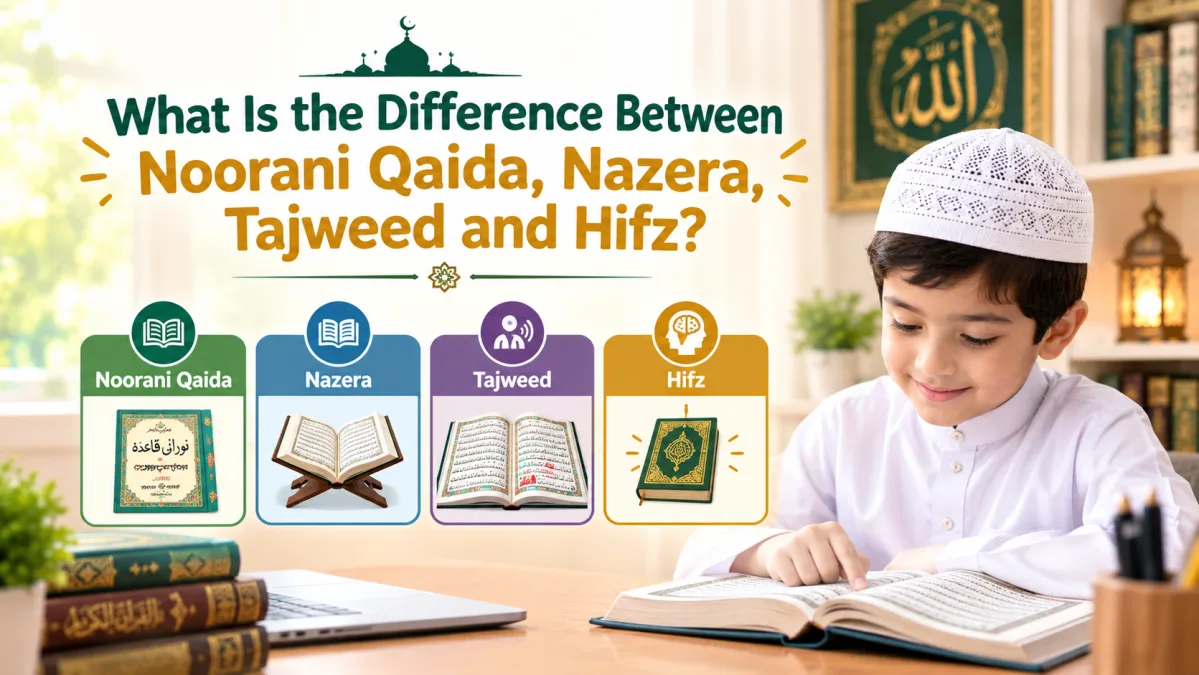
Noorani Qaida teaches the foundations of Arabic reading. Nazera develops the ability to read the Quran by looking at the text. Tajweed focuses on the rules of correct Quranic recitation. Hifz focuses on memorising the Quran.
For Bangladeshi families living in the UK, USA, Canada, Australia, Europe, or the Middle East, understanding these differences can help you choose a course that matches your child's current level.
At Learn Al Quran Online BD, children and adults can explore different Quran learning programmes according to their needs. In this guide, we will explain what each course means, how they are connected, and how to decide where your child should begin.
What Is the Difference Between Noorani Qaida, Nazera, Tajweed and Hifz?
The easiest way to understand these four terms is to look at the main skill each one develops.
| Course | Main purpose | Who may need it? |
|---|---|---|
| Noorani Qaida | Learn Arabic letters, sounds and basic reading | Beginners who cannot yet read Arabic confidently |
| Nazera Quran | Read Quranic text directly from the page | Learners who know the Arabic reading basics |
| Quran with Tajweed | Improve pronunciation and apply recitation rules | Learners who want to recite more accurately |
| Hifz Quran | Memorise Quranic passages and revise them regularly | Learners who are ready for a memorisation plan |
These are connected skills rather than four completely unrelated subjects. Many learners start with Noorani Qaida, progress to reading the Quran, improve their Tajweed, and later pursue Hifz. However, the right path depends on the learner's existing skills. Basic Tajweed principles can also be introduced during beginner reading lessons.
1. What Is Noorani Qaida?
Noorani Qaida is a beginner's learning book commonly used to teach the foundations of Quranic Arabic reading.
Before a child can read Quranic verses independently, they need to recognise Arabic letters, understand their sounds and learn how letters combine to form words. Noorani Qaida introduces these skills step by step.
What Does a Child Learn in Noorani Qaida?
A typical Noorani Qaida programme covers:
-
Recognition of Arabic letters and their different written forms.
-
Correct pronunciation of individual letters.
-
Short vowel signs, including Fatha, Kasra and Damma.
-
Tanween, Sukoon and Shaddah.
-
Long vowel sounds and basic reading patterns.
-
Combining letters and reading words.
The teacher demonstrates the correct sound, listens to the child's response, and corrects mistakes through repeated practice.
Who Should Start With Noorani Qaida?
Noorani Qaida is generally suitable for children who are new to Arabic reading or who still struggle to recognise letters and vowel signs.
For example, if your child can recite a few short surahs from memory but cannot read Arabic words independently, they may still benefit from structured beginner reading lessons.
Completing Noorani Qaida does not automatically mean that a learner has mastered every Tajweed rule. It provides a foundation for further reading and recitation practice.
Explore our Online Noorani Qaida Course.
2. What Is Nazera Quran?
Nazera, also written as Nazira or Nazrah, generally means reading the Quran by looking directly at the printed text rather than reciting entirely from memory.
After developing the necessary Arabic reading skills, a learner practises reading Quranic words, verses and pages aloud.
What Does a Child Learn in Nazera?
A Nazera Quran programme typically focuses on:
-
Reading Arabic words without spelling out every letter separately.
-
Recognising familiar Quranic reading patterns.
-
Developing reading fluency and confidence.
-
Practising correct pronunciation.
-
Reading longer passages with fewer unnecessary pauses.
-
Revising previous lessons and correcting recurring mistakes.
The teacher listens to the child's recitation and identifies areas that need further practice.
Who Should Learn Nazera Quran?
Nazera is generally suitable for children who can recognise Arabic letters and combine them into words but need to develop their ability to read the Quran.
For example, your child may have completed the main lessons in Noorani Qaida but still read slowly. A Nazera programme can help them practise reading directly from the Mushaf with greater confidence and accuracy.
Nazera does not mean that the child has completed Quran education. Learners may continue working on fluency, pronunciation, Tajweed and understanding as appropriate.
Explore our Online Nazera Quran Course for Kids.
3. What Is Tajweed?
Tajweed refers to the rules and principles used to recite the Quran correctly. It includes the proper articulation of Arabic letters, their characteristics, and rules affecting sounds and their duration during recitation.
Knowing how to read Arabic words is important, but accurate Quranic recitation also requires attention to how those words should be pronounced.
What Does a Child Learn in Tajweed?
Depending on the learner's level and curriculum, Tajweed lessons may include:
-
Makharij: The articulation points from which Arabic letters are pronounced.
-
Sifat: The characteristics of letters that help distinguish their sounds.
-
Noon Sakinah and Tanween rules: Rules governing the pronunciation of these forms in different contexts.
-
Meem Sakinah rules: Specific pronunciation rules involving Meem Sakinah.
-
Madd: Rules concerning the lengthening of sounds.
-
Ghunnah: Nasalisation in applicable recitation contexts.
-
Qalqalah: A particular echoing quality associated with certain letters in specified conditions.
-
Stopping and starting: Learning where and how to pause and resume recitation appropriately.
The exact topics and level of detail depend on the course.
Who Should Learn Tajweed?
Tajweed is important for learners who want to improve the accuracy of their Quranic recitation.
Children can begin learning basic pronunciation principles while studying Noorani Qaida. More detailed Tajweed instruction can be introduced as their reading develops.
For example, a child may be able to read a Quranic page but repeatedly mispronounce particular letters or apply lengthening rules incorrectly. Tajweed lessons can help address those weaknesses.
Tajweed and Nazera are not competing choices. Nazera describes reading from the text, while Tajweed describes the rules that guide correct recitation. A learner can practise both together.
Explore our Online Quran Tajweed Course.
4. What Is Hifz Quran?
Hifz means memorisation. In Quran education, Hifz refers to memorising Quranic passages and learning to recite them from memory.
Some learners begin by memorising short surahs, while others follow a structured programme with the goal of memorising larger portions or the entire Quran.
What Does a Child Learn in Hifz?
A structured Hifz programme generally involves:
-
Learning a new passage or set of verses.
-
Repeating the passage until it can be recited from memory.
-
Reciting memorised material to the teacher.
-
Correcting pronunciation and recitation mistakes.
-
Revising recently memorised passages.
-
Reviewing older memorisation regularly.
Revision is essential. Memorising new verses without returning to earlier passages can make it difficult to retain what has already been learned.
Who Should Start Hifz?
Hifz may be suitable for children who are interested in memorisation and can follow a consistent learning and revision routine.
A child does not necessarily need perfect reading fluency before memorising a short surah. However, for a structured Hifz programme, a reliable reading foundation and accurate pronunciation are important so that incorrect recitation is not repeatedly memorised.
Parents should discuss the child's current reading level, available practice time and learning goals with the teacher before choosing an intensive memorisation plan.
Explore our Online Hifzul Quran Course for Kids.
What Is the Correct Order for Learning These Quran Courses?
For many beginners, a practical learning path looks like this:
Noorani Qaida → Nazera Quran → Further Tajweed Development → Hifz, If Desired
This is a general pathway, not a compulsory sequence for every student.
Step 1: Build the Reading Foundation
Learn Arabic letters, their sounds, vowel signs and how letters combine into words.
Step 2: Develop Quran Reading
Practise reading directly from the Mushaf and gradually improve fluency and confidence.
Step 3: Improve Recitation With Tajweed
Study and apply the rules needed for more accurate Quranic recitation.
Step 4: Follow a Hifz Plan If Desired
Memorise new passages while revising previously learned material consistently.
The teacher may adjust this pathway after assessing the learner. For instance, a child who already reads the Quran fluently may not need to repeat a complete beginner course. Another child may need additional letter-recognition and pronunciation practice before progressing.
Can a Child Learn Nazera and Tajweed at the Same Time?
Yes. Nazera and Tajweed can be taught together because one focuses on reading from the Quranic text and the other focuses on how that text should be recited.
A teacher may introduce a Tajweed rule and then help the child apply it while reading a passage from the Quran.
This integrated approach can help children connect the rules they learn with their actual recitation. The appropriate level of Tajweed should match the child's reading ability so that lessons remain manageable.
Can a Child Start Hifz Without Completing Noorani Qaida?
It depends on the child's existing reading ability.
If a child already reads Quranic Arabic accurately, they may be ready to begin a memorisation programme without studying Noorani Qaida again.
However, if the child cannot yet recognise Arabic words confidently, it is usually sensible to strengthen their reading foundation first. This helps them memorise passages with more reliable pronunciation and makes independent revision easier.
A teacher can assess the child's reading, pronunciation and memorisation readiness before recommending the next step.
Which Quran Course Is Best for Your Child?
The best starting point depends on what your child can already do.
| Your Child's Current Ability | A Suitable Starting Point to Consider |
|---|---|
| Cannot recognise Arabic letters | Noorani Qaida |
| Recognises letters but struggles to combine them | Noorani Qaida or targeted reading support |
| Can read words but reads the Quran slowly | Nazera Quran |
| Can read the Quran but needs better pronunciation | Quran with Tajweed |
| Reads confidently and wants to memorise | Hifz Quran |
| Wants Quran reading alongside essential Islamic learning | Smart Maktab Learning may be suitable |
These are starting-point suggestions, not a substitute for a teacher's assessment. A learner may need a combination of reading practice, Tajweed and revision rather than a single course in isolation.
You can also explore Smart Maktab Learning if you want to discuss a programme that combines Quran learning with essential Islamic knowledge.
How Can Parents Choose the Right Online Quran Teacher?
When choosing an online Quran teacher for your child, look beyond the course name. The teacher's ability to identify your child's level and provide useful feedback is equally important.
Consider the following questions:
-
Does the teacher listen carefully to your child's recitation?
-
Can the teacher explain mistakes in language your child understands?
-
Is the pace appropriate for your child's age and current ability?
-
Does the lesson include revision as well as new material?
-
Can the teacher explain how progress will be assessed?
-
Are the available class times suitable for your family's time zone?
-
Can you discuss the teacher's language and other preferences before enrolment?
For Bangladeshi families abroad, a Bangla-speaking teacher may be particularly helpful when a child understands explanations more easily in Bangla.
At Learn Al Quran Online BD, parents can discuss their child's needs and available course options before deciding which programme to choose.
Frequently Asked Questions
Is Noorani Qaida the Same as Tajweed?
No. Noorani Qaida is a beginner's learning resource that develops Arabic reading foundations and may introduce basic pronunciation principles. Tajweed is the broader study and application of rules for correct Quranic recitation.
Is Nazera Quran the Same as Hifz?
No. Nazera means reading the Quran by looking at the text, while Hifz means memorising Quranic passages and reciting them from memory.
Which Course Should a Beginner Choose First?
A learner who cannot yet recognise Arabic letters will generally benefit from Noorani Qaida or equivalent beginner instruction. A teacher can recommend the starting point after checking the learner's existing skills.
Does a Child Need to Finish Tajweed Before Starting Hifz?
Not necessarily. Basic pronunciation and reading accuracy are important, but the exact timing depends on the child's current level and the memorisation programme. Tajweed learning and Hifz may overlap, with the teacher correcting recitation as memorisation develops.
Can Adults Learn Noorani Qaida and Tajweed?
Yes. Noorani Qaida can help adult beginners establish Arabic reading foundations, while Tajweed can help learners improve the accuracy of their recitation. The pace and lesson plan can be adapted to their experience.
How Do I Know Which Quran Course My Child Needs?
Consider whether your child can recognise Arabic letters, read connected words, read from the Mushaf, apply pronunciation rules and memorise passages reliably. If you are uncertain, ask a qualified teacher to assess your child before selecting a course.
Start Your Child's Quran Learning Journey
Noorani Qaida, Nazera, Tajweed and Hifz each play a different role in Quran education. Understanding these differences helps parents choose a suitable starting point instead of enrolling a child in a course that may not match their current ability.
For children who are just beginning, building a reliable reading foundation is often the first priority. As their skills develop, they can progress towards more fluent recitation, more detailed Tajweed study or Quran memorisation according to their goals.
Learn Al Quran Online BD offers several online Quran learning options for children and adults. Explore the available courses and book a trial class to discuss your child's learning needs.
Explore Our Courses: https://learnalquranonlinebd.com/en/courses
Book a Free Trial Class: https://learnalquranonlinebd.com/en/free-trial-class
WhatsApp: https://wa.me/8801410745663
Email: learnalquranonlinebd@gmail.com
Learn • Understand • Practice