



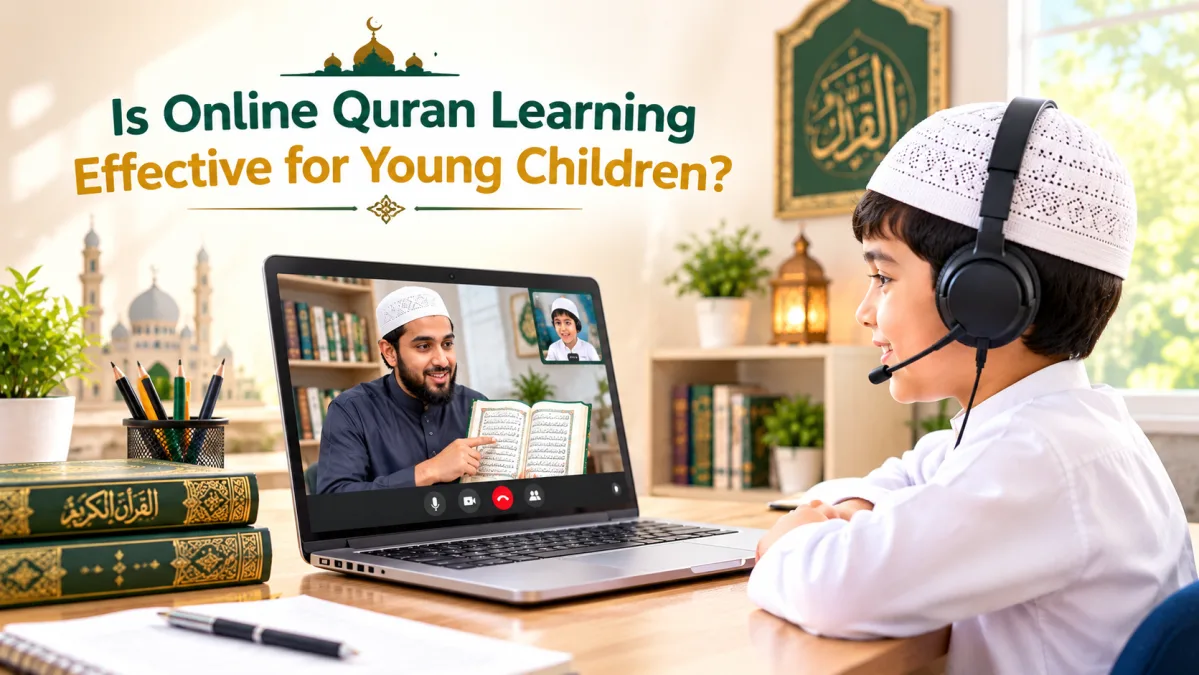
Is Online Quran Learning Effective for Young Children?
প্রবন্ধের সারসংক্ষেপ
~ 13 মিনিট পড়ার সময়Is online Quran learning effective for young children? Explore its benefits, challenges, age-appropriate courses and tips for helping your child succeed.
Is Online Quran Learning Effective for Young Children?
Yes, online Quran learning can be effective for young children when lessons are interactive, appropriate for their age, and supported by regular practice at home. For Bangladeshi families living in the UK, USA, Canada, Australia, Europe, or the Middle East, online classes can provide access to Bangla-speaking Quran teachers without requiring children to travel to a local learning centre.
However, success depends on more than having a computer and an internet connection. Young children need a patient teacher, manageable lessons, repeated practice, encouragement, and support from their parents.
At Learn Al Quran Online BD, children can learn through live online Quran lessons with Bangladeshi teachers who speak Bangla and English. Parents can explore different courses according to their child's age and current learning level.
If you are considering online Quran education for your child, this guide explains its benefits, limitations, and the practical steps that can help your child learn successfully.
Can Young Children Really Learn the Quran Online?
Yes, many young children can learn Quran reading and memorisation online, provided the teaching method suits their developmental stage.
A teacher can demonstrate Arabic letter sounds, listen to a child's recitation, correct pronunciation, repeat difficult sounds, and guide the child through short exercises during a live lesson.
Research on early Quran education highlights the importance of developmentally appropriate teaching, structured repetition, and cooperation between teachers and parents. A 2025 systematic review of early Quran reading instruction also identified home learning continuity and parental involvement as important factors in children's learning.
Online learning is not equally suitable for every child in every situation. Some children adapt quickly to a screen-based lesson, while others need more help staying engaged. The key is to evaluate the child's progress rather than assuming that online or in-person learning is automatically better.
7 Benefits of Online Quran Learning for Young Children
1. Access to Bangla-Speaking Quran Teachers
For Bangladeshi families living abroad, finding a suitable local Quran teacher who speaks Bangla may be difficult.
An online academy can make it easier to connect with teachers from Bangladesh. A Bangla-speaking teacher can explain unfamiliar concepts in a language the child understands while gradually developing the child's Arabic reading skills.
This can be particularly helpful for children who speak English at school but use Bangla at home.
2. Individual Attention During Lessons
In a live one-to-one class, the teacher can concentrate on one child's progress instead of dividing attention among several students.
For example, if a child confuses two Arabic letters, the teacher can repeat their sounds, demonstrate the difference, and ask the child to practise again.
Individual lessons also allow the teacher to adjust the pace according to the child's current ability. Some children need more time to recognise letters, while others are ready to practise connected words or Quranic verses.
3. Learning From Home
Online classes remove the need to travel to a Quran learning centre for every lesson.
This can be useful for families with busy school schedules, working parents, or limited access to suitable local classes. Children can attend lessons from a familiar environment, provided it is quiet and free from unnecessary distractions.
4. Flexible Scheduling Across Time Zones
Families living abroad often need to coordinate Quran lessons with school, homework, family activities, and bedtime.
Online classes make it possible to discuss available lesson times with an academy in another country. Parents should confirm the available schedule and ensure that the selected time is appropriate for their child's energy and concentration.
5. Regular Pronunciation Correction
Children learning Quran reading need opportunities to hear correct recitation and practise producing the sounds themselves.
During a live online lesson, a teacher can listen to the child read, identify mistakes, model the correct pronunciation, and ask the child to repeat it.
Parents should choose a class where children actively recite rather than simply listen to the teacher throughout the session.
6. Consistent Learning and Revision
Regular short practice sessions can help children build familiarity with Arabic letters, reading patterns, and memorised passages.
A good teacher revisits previously learned material instead of introducing new lessons every time. For children learning Hifz, revision is especially important because memorising new verses without reviewing previous ones can make retention more difficult.
7. Opportunities for Parent Involvement
Online lessons can help parents understand what their children are learning. Parents may be able to listen to recitation, review assigned practice, and discuss progress with the teacher.
A systematic review of early Quran reading instruction emphasises the value of continuity between formal instruction and learning at home. Parents do not need to become Quran teachers themselves; consistent encouragement and a simple practice routine can make a meaningful difference.
What Is the Best Age to Start Online Quran Classes?
There is no single starting age that suits every child. Readiness depends on the child's interest, ability to follow simple instructions, communication skills, and comfort with a live online lesson.
The following table provides general guidance rather than strict age limits.
| Age group | Possible learning focus | What parents should consider |
|---|---|---|
| Ages 3–4 | Gentle exposure to Arabic sounds, short surahs and simple duas | Keep sessions brief and playful; check whether the child is ready for structured online instruction |
| Ages 5–6 | Arabic letters, basic pronunciation and beginner reading | Use repetition, encouragement and simple activities |
| Ages 7–9 | Noorani Qaida, Quran reading and introductory Tajweed | Build consistent reading practice and correct mistakes patiently |
| Ages 10–12 | Nazera, Tajweed development or a suitable Hifz plan | Set realistic goals and encourage independent revision |
These are flexible guidelines. A child who starts later can still develop strong Quran reading skills, and a younger child may need a slower introduction.
How Can Parents Keep Young Children Focused During Online Quran Lessons?
One of the most common parental concerns is whether a young child can concentrate during a video call. The answer depends partly on the child and partly on how the lesson is organised.
Here are practical ways to improve the learning environment.
Choose a Quiet Learning Space
Set up the device in a quiet area with good lighting and a stable internet connection. Close games, unnecessary browser tabs, and other applications that may distract the child.
Use an Age-Appropriate Lesson Length
A long lesson is not automatically more effective. Young beginners may benefit from shorter sessions with frequent changes between listening, repeating, reading, and revision.
Ask the teacher whether the lesson length can be adjusted if your child regularly becomes tired or loses concentration.
Prepare Before Class
Help your child use the bathroom, drink water, and settle down before the lesson begins. Keep the required Qaida or Quran ready so the child does not have to search for materials during class.
Encourage Without Taking Over
For a very young child, a parent may need to sit nearby and help with the device or learning material. As the child becomes more confident, the parent can gradually step back while remaining available.
Avoid correcting every mistake at the same time as the teacher. Too many instructions can confuse a beginner.
Make Revision a Daily Habit
A short, predictable revision routine is often more manageable than a long practice session once or twice a week.
Follow the teacher's guidance about what to revise. Praise effort and improvement rather than comparing your child with other children.
What Are the Limitations of Online Quran Learning?
Online Quran education has genuine advantages, but parents should understand its limitations before enrolling.
Screen-based distractions: A child may become distracted by games, notifications, or activity around the room. A dedicated learning space can help.
Internet and audio problems: Poor sound quality or an unstable connection can make it difficult for the teacher to hear pronunciation accurately. Test the microphone and connection before class.
Need for adult support: Very young children may struggle to operate the device, find the correct page, or remain engaged without an adult nearby.
Different learning preferences: Some children respond better to face-to-face instruction or a physical classroom environment. If your child consistently struggles online, consider changing the lesson format, teacher, duration, or learning arrangement.
Limited value of passive screen time: Leaving a child to watch Quran videos is not the same as receiving live instruction. Young learners need opportunities to recite, receive feedback, ask questions, and practise.
The goal is not simply to complete online lessons. It is to help children develop accurate reading, consistent practice, and a positive relationship with Quran learning.
Which Online Quran Course Should You Choose for Your Child?
Choosing the right starting point is important. A child who has not learned Arabic letters may struggle if placed directly into a Quran reading or Tajweed class.
Learn Al Quran Online BD offers several learning options for children and families.
| Course | Suitable learning goal |
|---|---|
| Noorani Qaida | Learning Arabic letters and the foundations of reading |
| Nazera Quran | Developing Quran reading fluency |
| Quran with Tajweed | Improving pronunciation and applying Tajweed rules |
| Hifzul Quran | Following a structured Quran memorisation programme |
| Smart Maktab Learning | Combining Quran learning with essential Islamic knowledge, duas and manners |
You can explore the courses here:
If you are unsure which course your child needs, discuss their current reading level with the academy before enrolling.
How Can You Tell Whether Online Quran Learning Is Working?
Parents should look for gradual, observable improvement rather than expecting every child to progress at the same speed.
Over time, you may notice that your child:
-
Recognises more Arabic letters and sounds.
-
Reads familiar material with greater confidence.
-
Makes fewer repeated pronunciation mistakes.
-
Remembers previously learned letters, words, or verses.
-
Follows lesson instructions with less assistance.
-
Develops a more consistent revision routine.
Progress will vary according to the child's starting level, lesson frequency, practice habits, and individual learning needs.
If progress appears slow, speak with the teacher. The child may need additional revision, a different teaching approach, shorter lessons, or more support at home.
Why Consider Learn Al Quran Online BD?
Learn Al Quran Online BD provides live online Quran and Islamic education for children and adults, including Bangladeshi families living abroad.
The academy offers courses covering beginner Quran reading, Nazera, Tajweed, Hifz, and essential Islamic learning. Bangla- and English-speaking teachers can help children learn in a way that supports their language needs.
Parents can discuss the child's current ability, suitable course, class timing, and available teacher options before making a decision.
A practical way to begin is to arrange a trial lesson and observe whether your child feels comfortable, participates actively, and responds well to the teacher.
Start here:
-
Visit the online Quran courses page.
-
Choose a course that matches your child's current learning level.
-
Book a free trial class.
-
Ask the team about available schedules and the current course fee.
You can also contact the academy through WhatsApp or email learnalquranonlinebd@gmail.com.
Frequently Asked Questions
Is online Quran learning effective for a five-year-old?
It can be effective if the child is ready for a structured lesson and the teacher uses simple explanations, repetition, encouragement, and age-appropriate activities. Parents may need to stay nearby to help the child remain engaged.
Can a child learn Quran online without knowing Arabic?
Yes. A child can begin with a suitable introductory course, such as Noorani Qaida, to learn Arabic letters and basic reading skills before progressing to more advanced Quran reading.
Are online Quran classes better than local Quran classes?
Neither option is automatically better for every child. Online classes offer convenience and access to teachers in different locations, while in-person classes may suit children who need a physical classroom or more direct supervision. The best choice depends on the child's needs and the quality of instruction.
How can parents help children practise between classes?
Follow the teacher's revision instructions, establish a consistent practice time, listen when possible, and encourage your child patiently. Short, regular practice is often easier to maintain than occasional long sessions.
Does my child need a parent beside them during every online Quran class?
Very young children may need close supervision and help with the device. Older children who can follow instructions independently may need less direct assistance. Parents should remain available according to the child's age and needs.
Can children living abroad learn Quran with Bangla-speaking teachers?
Yes. Online classes allow families abroad to access Bangla-speaking teachers from Bangladesh. This can be helpful when children understand explanations more easily in Bangla while learning to read the Quran in Arabic.
How can I know if an online Quran teacher is suitable for my child?
Arrange a trial lesson if available. Observe whether the teacher speaks patiently, listens to the child's recitation, corrects mistakes clearly, adapts to the child's level, and encourages participation. Ask how progress is reviewed and how parents can communicate with the teacher.
Help Your Child Begin Quran Learning With Confidence
Online Quran learning can be a useful option for young children when it combines live teacher interaction, age-appropriate lessons, regular revision, and support from parents.
For families living abroad, it can also make access to Bangla-speaking Quran teachers more convenient. Take time to choose a suitable course, ask questions about the teaching method, and see how your child responds during a trial class.
Explore Learn Al Quran Online BD and book a free trial class to discuss your child's learning needs.
Learn • Understand • Practice
Connect With Learn Al Quran Online BD
-
Website: https://learnalquranonlinebd.com/en
-
Free Trial Class: https://learnalquranonlinebd.com/en/free-trial-class
-
WhatsApp: https://wa.me/8801410745663
-
LinkedIn: https://www.linkedin.com/company/learn-al-quran-online-bd/